The Rise of JavaScript
In this blog, we will understand the incredible rise of JavaScript, how a simple language meant to manipulate HTML and CSS broke out of the browser, what problems it solved along the way, and how it came to rule the programming world.
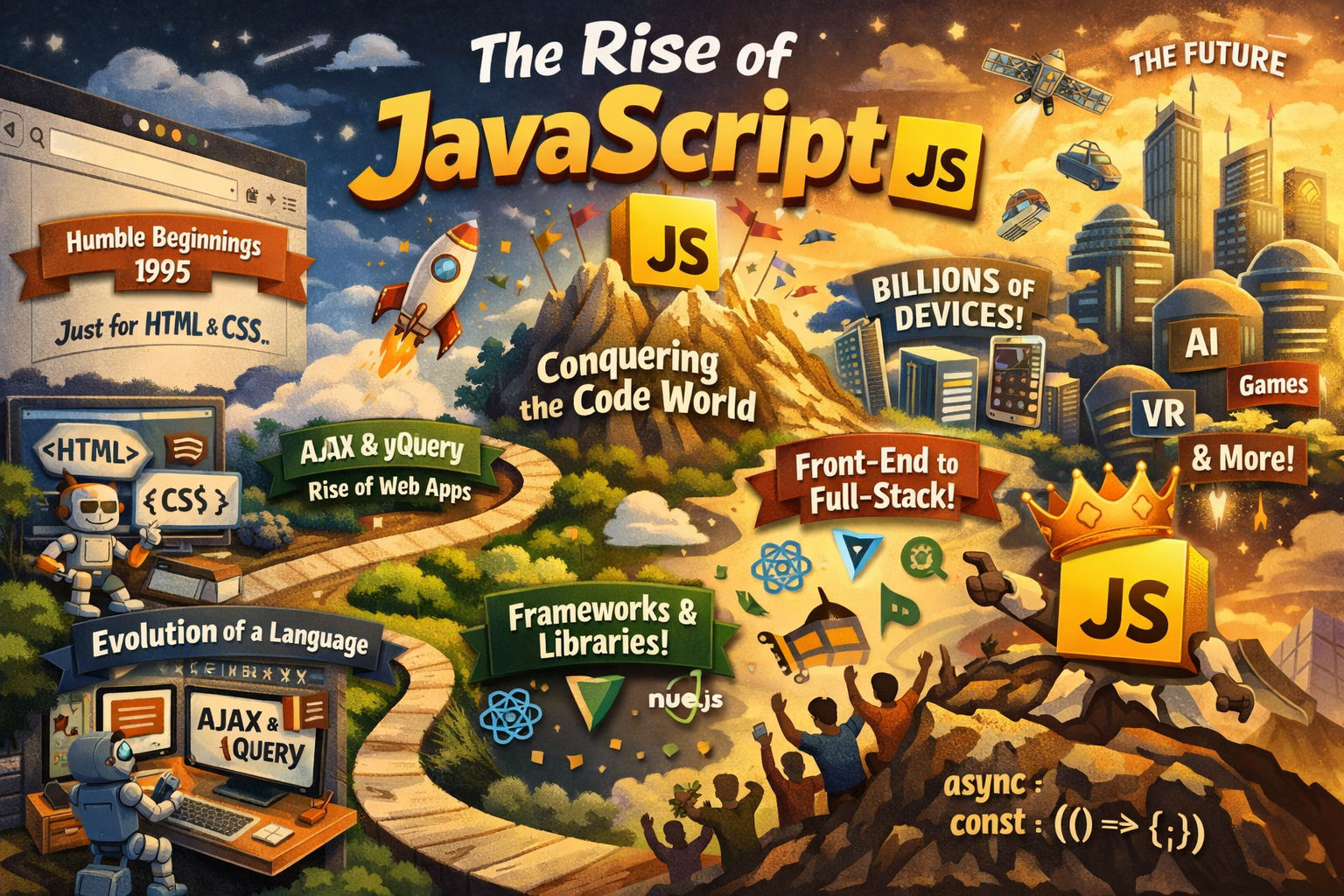
Every day, billions of people open their web browsers, click buttons, scroll through endless feeds, and watch real-time updates without the page ever refreshing. But the web wasn't always like this. In the early days, websites were just static documents. To make them interactive, we needed a scripting language.
In this blog, we will understand the incredible rise of JavaScript, how a simple language meant to manipulate HTML and CSS broke out of the browser, what problems it solved along the way, and how it came to rule the programming world.
First, let’s understand what JavaScript was originally meant for.
What JavaScript was originally meant for
In 1995, websites were built using only HTML (for structure) and CSS (for styling). They were like digital magazines, you could read them, but you couldn't really interact with them.
Netscape, the company behind the most popular browser at the time, wanted to make the web feel more alive. They hired a developer named Brendan Eich, who created a lightweight scripting language in just 10 days. It was eventually named JavaScript.
It was never intended to build massive, complex applications. It was simply meant to be an HTML and CSS manipulator to handle basic tasks:
-
Show a pop-up alert when a button is clicked.
-
Check if a user filled out a password field before submitting a form.
-
Change an image when your mouse hovers over it.
Because it was so easy to use, every web browser adopted it. But as the internet grew, developers wanted to do more than just simple intrection.
The Turning Point – AJAX
When data is requested on a traditional website, the server sends back a completely new page. Every single click meant a full page reload, which was slow and frustrating.
In the mid-2000s, a concept called AJAX (Asynchronous JavaScript and XML) became popular.
These are just buzz words, let’s understand them.
AJAX allowed JavaScript to talk to the server in the background and load new data without refreshing the whole page.
You can think of it like reading a book where the text magically updates itself without you having to turn the page.
This is what made applications like Gmail and Google Maps possible. You could drag a map around, and JavaScript would fetch the new map tiles seamlessly in the background.
The Engine that changed everything: Google V8
As developers started building heavier applications like Gmail, JavaScript started to feel very slow. Browsers were struggling to read and execute the code fast enough.
In 2008, Google released the Chrome browser, and inside it was a secret weapon: the V8 Engine.
Instead of just reading JavaScript line-by-line (interpreting), the V8 engine translated JavaScript directly into super-fast machine code that the computer's CPU could understand instantly.
Suddenly, JavaScript was lightning fast.
The Big Grouth: Node.js and the Server-Side
Even with its new speed, JavaScript was still trapped inside the web browser. It could not save files to a computer, it could not talk directly to databases, and it could not run a backend server.
In 2009, a developer named Ryan Dahl had a brilliant idea. He took Google's powerful V8 engine, pulled it completely out of the browser, and wrapped it in a new program called Node.js.
Node.js allowed developers to write backend server code using JavaScript.
Why was this a big deal?
-
One Language: Before Node.js, you needed to know JavaScript for the frontend, and a completely different language (like PHP, Python, or Java) for the backend. Now, developers could write both ends in JavaScript.
-
Speed: Node.js was designed to handle thousands of connections at the same time without slowing down, making it perfect for real-time apps like chat platforms and live streaming.
This birthed the era of the Full-Stack JavaScript Developer.
The Modern Era: Frontend Frameworks
As companies moved their entire software platforms to the web, raw JavaScript code became messy and hard to manage. To solve this, developers created "Frameworks" and "Libraries", pre-written sets of JavaScript rules that make building complex websites much easier.
-
React (by Facebook): Focuses on building reusable "components" (like a custom button or a chat window) so you don't have to write the same code twice.
-
Angular (by Google) & Vue: Provide full, structured environments for building massive Single Page Applications (SPAs).
These tools turned JavaScript from a simple HTML manipulator into a heavy-duty software engineering tool.
Conclusion
JavaScript is a powerful, flexible language that went from a rushed 10-day side project to the absolute backbone of the Internet. It survived browser wars, adapted to backend servers via Node.js, and evolved through powerful frameworks like React. Without JavaScript, the modern, fast, and interactive web simply would not exist.
Understanding this journey helps you see how a simple tool designed for basic pop-ups grew up to power everything from enterprise banking apps to Netflix and Uber.
We also have TypeScript, which is a stricter, safer version of JavaScript that catches errors before you even run the code.
Enjoyed this article?
If you found this helpful, I'd appreciate it if you shared it with your network!